Yale School of Management
Apply MBA
Visit
Give
Recruit & Hire
View News & Events
Contact

Alumni Profile: Eddie Tam '93, CEO, Central Asset Investments

Posted on: March 2, 2011

When Eddie Tam graduated from Yale SOM in 1993, he wanted to be an entrepreneur. His family had owned a series of stores in Hong Kong when he was young, and though his mother moved the family to Canada when Tam was 12, these early experiences stayed with him. "I learned a lot of crucial skills that would help me start my own business," he said. "The only problem was I had about $100 in my bank account, so I knew it wasn't time for me yet."

Instead, Tam, who started his career in engineering before moving into finance, went to work for Merrill Lynch in the company's equity derivatives area. Eighteen years ago, U.S. banks were beginning to change their approach to investing in Asia, shifting away from viewing the region through the lens of Tokyo. Even though Tam had lived in the U.S. and Canada for most of his life, he was fluent in Chinese and was an easy choice to go to Hong Kong to help Merrill Lynch build its China operations. At the time, he didn't see the posting as a permanent assignment. "I would've been quite happy to continue my career in New York," he said.

Tam said that 1993 was the year the West discovered China as an asset class. Over the next several years, banks rushed to set up shop, first in Hong Kong and then on the mainland. The country went from desperate for hard currencies like the U.S. dollar to a growing financial power. Tam moved over to Credit Lyonnais, where he headed its derivatives unit. But while he was successful, Tam couldn't shake the old desire to go out on his own, so he quit Credit Lyonnais in 2002 to begin investing for himself, contemplating what to do next. In early 2003, SARS hit Hong Kong, so Tam moved to Australia and New Zealand for several months. Upon his return, he saw an opportunity to start a business, and he paired up with an old Merrill Lynch acquaintance on a fund focusing on investing in fixed instruments. "The SARS epidemic was really bad, and I thought that this was going to be the absolute bottom, and in a contrarian way it was a good time to begin investing again," he said.

The pair did well, but Tam wanted to do more with equities, so he and his partner split. In 2005, he founded Central Asset Investments, where he is chief executive officer. The Asia-focused firm did well from the start, winning AsianInvestor's Fund of the Year: Asia ex-Japan award for its 2007 performance. But while things were going well, Tam saw trouble on the horizon. By the second half of 2007, the firm began moving out of equities, decreasing its exposure to the riskiest asset classes. When the financial crisis arrived, Central Asset Investments had already shifted much of its funds into Asian bonds. "Out of all our investments we only took a haircut once," he said. "This was remarkable because supposedly the world was coming to an end. The global financial system came very close to collapsing entirely. But we had a lot of confidence in our portfolio and soon after the worst had passed, our investments began to recover. Within a year we had recovered to our so-called high-water mark and a year later we were 40% above that. I'm proud of our performance."

For 2010, the fund's return topped 48%, helping it to earn another award from AsianInvestor, this time for all of Asia. Since its inception, Tam said Central Asset Investments has averaged over 32% annualized return. Even during the worst days of the crisis, Tam never doubted his decision to go out on his own. He may have given up the security of working for a large, international firm, but he gained a sense of freedom and accomplishment that, he said, could never come from working for someone else. "If you are really good at what you're doing, you will come to an intersection point whereby you have enough capital to launch your own venture," he said. "For me, it has been a tremendously satisfying experience. It gives me a lot of freedom. It gives me a lot of independence, intellectually, so I can express my thoughts and my investment views according to how I see things."


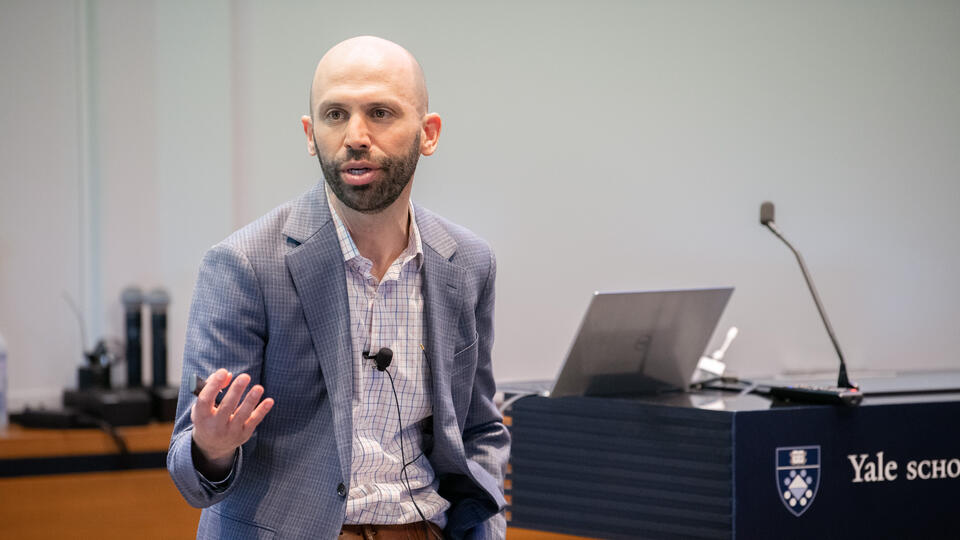
Eddie Tam
Watch an interview with Eddie Tam '93 on China, the financial
crisis, and on being an entrepreneur.