Yale School of Management
Apply MBA
Visit
Give
Recruit & Hire
View News & Events
Contact

SOM Veterans Share Stories of Leadership with Fellow MBA Students

Posted on: November 11, 2009

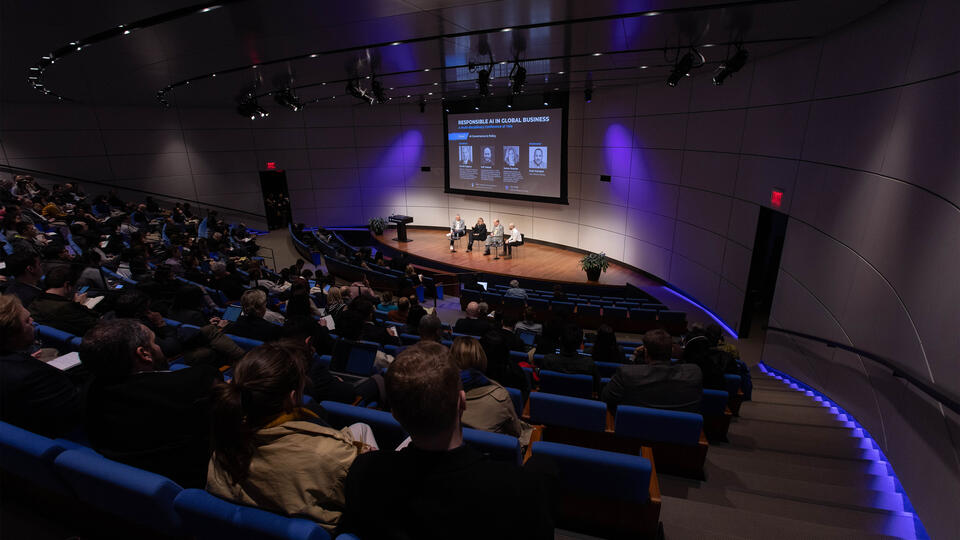
Leadership tests come in many forms. For five current Yale SOM students, they came not in the boardroom, but on the battlefield. The five shared their stories with fellow MBA students on November 10, on the eve of Veterans' Day, a holiday that all of them said has taken on greater meaning since they were deployed overseas. K.C. Bennett '10, who left active duty as a captain in the Army for the Connecticut National Guard last year, explained to the audience how he and the others believe it’s necessary for people to hear about life in the military, especially during a time of war. "It’s important for us to share this," he said. "And for us, it’s not good to bottle it up inside."

While all five had very different experiences in the military, their stories all revolved around the leadership lessons they drew from their time abroad. For Vu Ho '11, who enlisted in the Marines after high school, leadership was just one of the things that attracted him to the military, where he quickly tried out for the Special Forces. "I wanted to do the cool stuff you see on TV," he said. Deployed in Iraq in 2004 and 2005, his job was to track down and capture high-value targets. During one mission, insurgents ambushed his platoon. "We were leaving after capturing a suspect when there was a huge explosion," said Ho, who was a sergeant. "You have to make life and death decisions at moments like this. It’s very intense and there’s a tremendous amount of responsibility. But it’s what we did every day over there."

Christine Knorring '11, an active-duty captain in the Air Force, spent six months last year overseeing some construction projects in Mosul. Like Ho, she was attracted to the military lifestyle, particularly its structure and sense of purpose. But she acknowledged that the nature of being in the military requires a person who is inherently flexible. "You don’t get to choose where you live, your job, the hours — and you can be sent overseas," she said. "You really need to be on board with the mission and why you’re serving." Once overseas, soldiers, Marines, and airmen must integrate with a culture that is completely foreign to most of them. Each said they employed translators, whether in Iraq or Afghanistan, but that they worked to learn the customs of the population. "We tried to learn at least a little bit of the language," said Alexandra Minor '11, who is now a captain in the Army Reserves and did two 12-month tours in Iraq. "We could say hello and goodbye. I learned how to say 'Where’s the kitty cat?'" She added: "There were a lot of stray cats on base."

With all but Knorring transitioned out of the regular military, the group reflected on how their lives have changed since coming back to the United States and how their futures will continue to be influenced by their time in the services. Bennett, who started a nonprofit aimed at helping returning veterans, said that to a certain extent you never fully leave the military. Ho said he misses much of his life in the Marines, especially jumping out of airplanes. "I also miss being in the middle of the Atlantic swimming in the ocean — I’ll never experience that again," he said. "I can’t work a 9-5 job. I need something with adrenaline. It’s why I’m considering banking."

While the five shared their experiences and looked toward the future, the point of the event was ultimately for the group to mark Veterans’ Day. And that invariably means remembering people they served with who were killed in action. "One close friend was killed," said Harry Park '11, who served as an Army captain in military intelligence in Korea, tracking, among other things, the movements of the North Korean leadership. "We remember the soldiers we led. It’s a time for reflection."


Read a fellow student’s reflections on the Veterans’ Day panel on the Yale SOM Community Blog.