| News |
Gender Stereotypes at Work
In surveys conducted by Catalyst, female executives at the vice president level or above in Fortune 1000 companies have cited stereotypes and preconceptions of women as one of the most significant barriers to women’s advancement in the workplace.
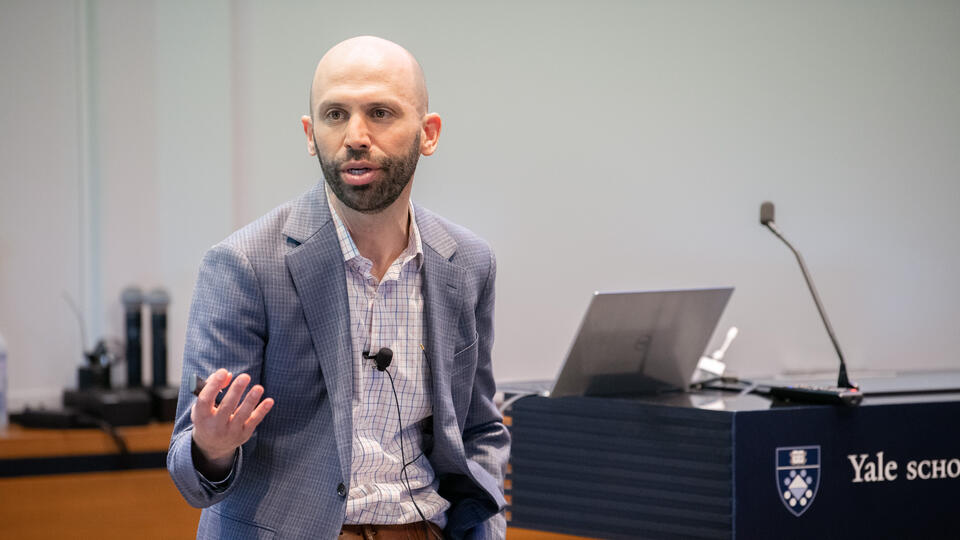
On December 1, Victoria Brescoll, assistant professor of organizational behavior, presented a lecture as part of the Women in Management club’s monthly "First Monday" speaker series in which she discussed what she described as "one of the strongest gender stereotypes": the idea that women are more emotional than men.
Brescoll is a social psychologist whose area of expertise is women in the workplace. In her talk, she discussed three of her recent research studies that examine how people perceive men and women differently when they express anger at work.
The first study she discussed, "Can an Angry Woman Get Ahead?," was recently published in Psychological Science. Previous research examined anger as a status cue and found that people will give more status to men who express anger. With this study, Brescoll wanted to know if the same would hold true for women. She found that is does not; when women express anger at work they experience a backlash.
The study participants, all working adults, watched a video of job interviews in which the men and women interviewees were asked to describe a time when something went wrong at work and whether it made them feel angry or sad. After watching the video, the participants were asked to rate them on factors such as their status and the salary they should earn.
The angry man was perceived as higher status, more competent, more likely to be hired, and given the highest salary. The angry woman was viewed as lower status and less competent than both the angry and sad men, and the sad woman. She also earned $14,000 less than the angry man and $5500 less than her sad female counterpart.
Brescoll’s research suggests that female leaders suffer from expressing anger when male leaders benefit from the same behavior due to prescriptive gender stereotypes — beliefs about how men and women should behave. Women are expected to be kind, not angry, and they are punished if they violate this "prescription for behavior."
What can women do to mitigate a backlash in response to their anger? Brescoll has found that providing a credible explanation for the anger is a simple, yet effective strategy.
She described another study that featured videos of job interviews in which the men and women were either angry, showed no emotion, or explained why they were angry. Again, the angry man was perceived as being higher status, and the angry woman had the least status. When the angry man explained his anger, his status dropped. "Angry men are better off not explaining themselves," said Brescoll.
However, the angry woman who explained her anger with a straightforward, two-sentence reason was perceived as having nearly as much status as the angry man and her salary increased. "A simple explanation was a powerful thing," she said.
Brescoll discussed a final study aimed at understanding whether some of these findings apply to real world organizations. Will people conform to gender stereotypes of emotion display rules? Will men express more anger than women? If anger confers more status for men, will men express more anger?
To answer these questions, Brescoll looked to the U.S. Senate, a complex organization where the main currency is status and power, and the senators’ floor speeches are conveniently filmed.
She taped twenty random days of C-SPAN’s Senate coverage in 2005 and coded the intensity and frequency of anger in each floor speech. She also used an independent measure of power and status in the Senate produced by Knowlegis (2005) that ranked each senator based on factors such as position, influence, and legislative actions.
Brescoll found gender differences in the Senate. Male senators displayed more anger in their floor speeches than female senators.
"It was interesting how relatively unemotional some of the female senators were compared to the male senators. Regardless of how much power women have, they’re still not expressing anger."
The higher status male senators also displayed more anger than their lower-status counterparts.
Brescoll is starting a new research project that will try to understand the strategies successful women use to manage how they express themselves and avoid the consequences of the angry woman phenomenon. In the meantime, Brescoll offered advice to the women in the audience.
"There are situations at work where anger is normal, but women have to be careful. You have to walk a fine line between not being completely unemotional and appearing cold and not displaying emotion that will harm you and have negative consequences."
In the spring semester Brescoll will teach a new course, "Managing a Modern Workforce," that will address some of the issues discussed in her lecture.