Yale School of Management

A New Look at Nonprofits

Ian Moss '09 has spent a lot of time thinking about how blue-collar neighborhoods get transformed first into artist colonies and then to the hot spots in town. He’s been researching the trend throughout New York City, where he lived before coming to SOM. His findings might not fit easily into the structure of most business classes, which might explain why he presented them at OrgEff on April 2.

OrgEff stands for Organizational Effectiveness. Not a formal course, it’s a weekly non-credit seminar that brings together students, faculty, and practitioners interested in improving the effectiveness of nonprofit organizations. OrgEff was started two years ago by Garry Brewer, the Frederick K. Weyerhaeuser Professor of Resource Policy and Management. He saw the seminars as a way to bolster the teaching going on in classrooms. "Most of the people attracted to nonprofits and NGOs are there for the mission, not to optimize the bottom line," he said. "But there are hundreds of billions of dollars pouring into these organizations and there is a real need to find people who can manage them properly. They need to begin looking like real businesses, and they need people with MBA skills."

Presentations are given by students from around the university, faculty, and some outside speakers, including the former COO of the U.S. Forest Service, the Minister for Environment and Sustainability of the Brazilian State Amazonas, a senior program officer from the Gordon and Betty Moore Foundation, and a sociologist involved in sea turtle conservation who is now working on a case on the effort for SOM. Subjects discussed this year included a look at the effectiveness of microfinance in developing countries, a workshop on grant writing, a study of how much American households are supporting international aid organizations, and how well e-mail works as an organizing tool. The format of OrgEff is designed to be pretty loose. It’s held over lunch, with each presenter talking for 20 minutes before opening it up to the room for questions and suggestions. Brewer said the only requirement for membership is that members are expected to participate, whether it’s organizing a seminar or actually leading a talk. "They can talk about a project or a job experience in an organization — the whole point is to start a conversation," he said.

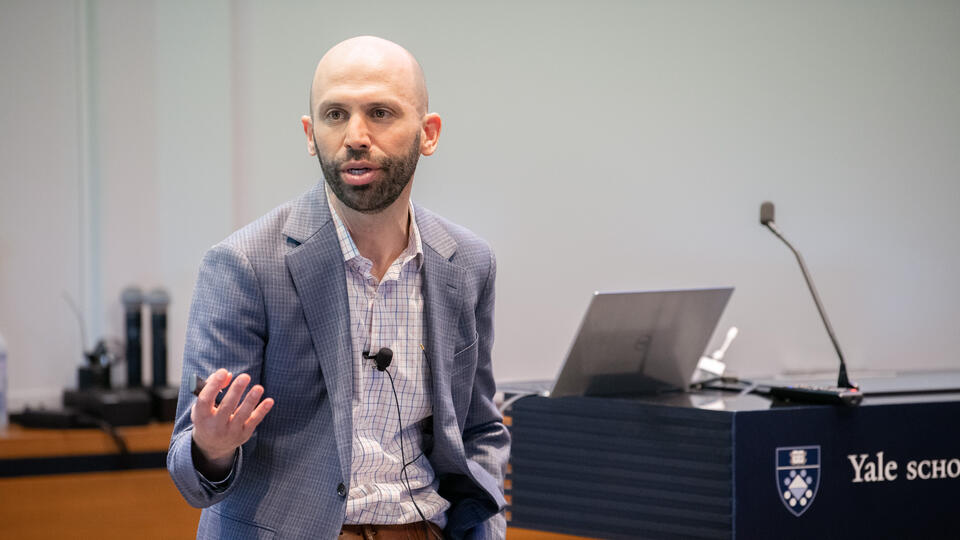
On April 2, it was Moss’ turn at the podium. Moss, who writes a blog about the intersection of business and the arts, tracked how neighborhoods in New York such as Williamsburg and Chelsea — as well as other places such as New Bedford, Massachusetts — have been transformed by the arrival of artists and arts organization. The places he focused on were all considered struggling and in some instances brought artists in to help revitalize the economy. He said he’s still working on the project, which aims to understand the nature of this type of gentrification and find ways to make it work better for small arts organizations (big ones dominate the grant process) and the residents who get pushed out by rising property values. One proposal, he said, was obvious: getting incoming artists and long-time residents to communicate more over the direction of the neighborhood. "I’ve also been thinking about something along the microfinance model," he said. "I call it microphilanthropy, where the money would start as small grants and you’d mix in a greater percentage of loans as the organization grows."

The emphasis on small organizations stems from his belief that the current model of artistic gentrification — sizable amounts of money for large venues or museums — may not be the best way to use art to help an area. "The theory is that if you plop a performing arts center in the middle of downtown, people will come and create a community," he said. "But look at Lincoln Center. It’s like an oasis, with a very high-powered arts organization, but no affordable places to eat. It’s not exactly an inviting, accessible neighborhood.”

Moss’ presentation provoked a discussion about the nature of gentrification, the conditions that must exist for it to occur, and if there’s a moral dimension to the transformation of blue collar neighborhoods into artist enclaves. Two weeks earlier, Lisa Bates ’09 spoke about her plan to launch an organization in her town in Connecticut aimed at helping low-income mothers learn the skills necessary to get better jobs. "There are no good resources for a mother who doesn’t have a lot of skills," she said. "They have no way of moving up. When I presented my plan at OrgEff, the feedback was incredibly helpful. What’s great about the seminars, and SOM in general, is whenever I have a thought, there’s someone really smart I can ask."