| News |
A Hinge Moment
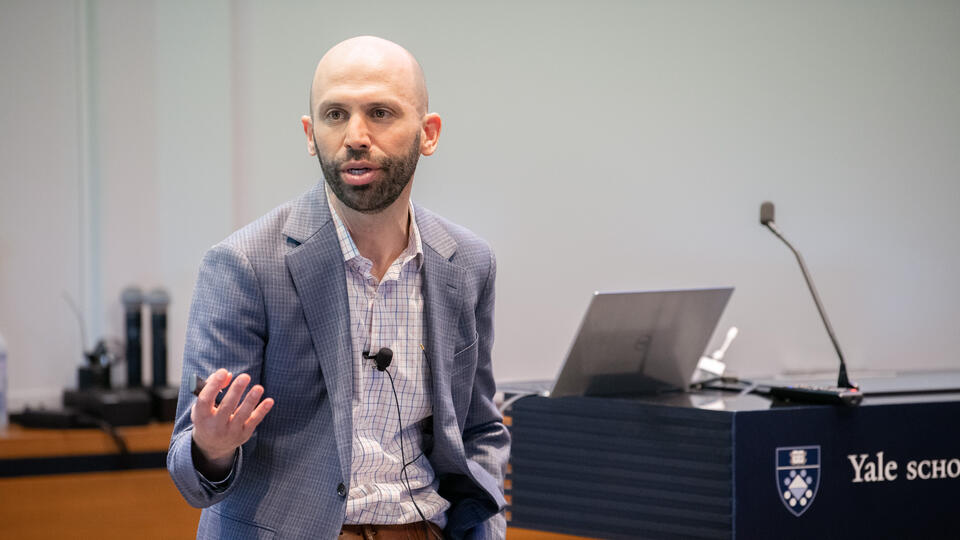
Yale SOM faculty member Douglas W. Rae’s latest book deals with a turbulent moment in the history of New Haven—and of Yale. The book, Murder in the Model City: The Black Panthers, Yale, and the Redemption of a Killer, examines events surrounding the 1969 murder of Alex Rackley, a young acolyte of the radical Black Panther Party, by his fellow Panthers. It was co-written with Paul Bass, a New Haven journalist, SOM lecturer, and one-time student of Rae’s.
“The period that the new book covers is one of the hinge moments in the city’s history,” Rae says. “It’s the moment at which racial mistrust came to the fore for the first time as a dominant issue in the city.”
The “redemption” in the title is that of Warren Kimbro, who pled guilty to second-degree murder in the case, but began attending Eastern Connecticut State University and working as a drug counselor while still in prison and now runs Project MORE, a New Haven program that works to reintegrate former prisoners into society.
“Warren Kimbro was eager to get this off his chest, partly as an expiation of the past,” Rae says.
A native of New Haven, Kimbro was working for an anti-poverty group in the city in early 1969, when the Black Panthers recruited him to help launch a local chapter. Within a few months, the Panthers had moved their headquarters into Kimbro’s apartment; he was present as several members questioned and tortured Rackley, a 19-year-old acolyte who had been accused — apparently without justification — of being an FBI informant. On May 20, Kimbro and others drove Rackley to a secluded spot in rural Middlefield, Connecticut, where, on the orders of another Panther, Kimbro shot Rackley in the head.
The book delves into many of the controversies that still surround these dramatic events. Even when it isn’t clear which version of events is correct, the book assembles all the possibilities in one place. “And where we can make the inference, we do,” Rae says.
For instance, previous accounts have repeated the rumor that Kimbro was himself an FBI plant; Rae and Bass say that there isn’t evidence to support that assertion.
By the spring of 1970, Kimbro had pled guilty to second-degree murder and had begun the process of rehabilitation that would lead to his release after four years. Meanwhile, however, Connecticut authorities had charged Bobby Seale, the charismatic national chairman of the party and Erika Huggins, one of its leading women members, with ordering the murder (they would eventually be freed after a New Haven jury was unable to reach a verdict).
As pretrial hearings neared, the Panthers, student activists, and other radicals planned a protest on the New Haven Green on May 1 — May Day — to demand Seale’s release. Fed by alarmist predictions from J. Edgar Hoover’s FBI, which chose to accept the assertions of Panther propaganda at face value, authorities became convinced that the protests would draw hundreds of thousands and lead to major violence. Those fears were heightened when on April 15 protesters in Cambridge, locked out of the Harvard campus, clashed with police. The Nixon administration ordered National Guard troops to the New Haven.
“One of the spectacular facts about this era is delusional belief on both sides about the potency of the Panthers,” Rae says. “I think Nixon and Agnew would have been privately quite pleased if all hell had broken loose in New Haven, because New Haven was in many ways the poster child for the Great Society and model city policies of Lyndon Johnson and the Democrats who came before.”
In an effort to prevent violence, Yale president Kingman Brewster took a “softer, smarter course” than Harvard did. The gates to Yale’s Old Campus would be kept open; protesters would be given space to sleep and served granola in the courtyards of the residential colleges. Speaking to a packed faculty meeting, Brewster said that he was “skeptical of the ability of black revolutionaries to achieve a fair trial anywhere in the United States.” His words and actions angered some alumni, but they defused tensions among the students. In the end, the protests were mostly peaceful.
“It’s actually quite a bright moment in Yale history,” Rae says. “It took real courage for a sitting president of Yale with a largely conservative, business-oriented alumni body."
The last section of Murder in the Model City follows Kimbro as he struggles to rebuild his personal life and becomes a community leader, working with many of the police officers and politicians who had once faced off with the Panthers.
“The later part of Warren Kimbro’s life—the period after he left prison—is a stunning story,” Rae says. “He goes from prison to Harvard, and at Harvard earns a graduate degree in education. And then comes back to New Haven to run what becomes Project MORE, which is a terrifically important institution.”
Rae argues that this rehabilitation was made possible by the prison policies that allowed Kimbro to pursue his education and even to work outside prison while still serving his sentence. “There was still a certain kind of optimism in the country about what was possible in the way of criminal rehabilitation. We could use a little more of that optimism still.”
Murder in the Model City was published by Basic Books in August 2006.