| News |
Yale School of Management Debuts Professor Robert Shiller's New Book
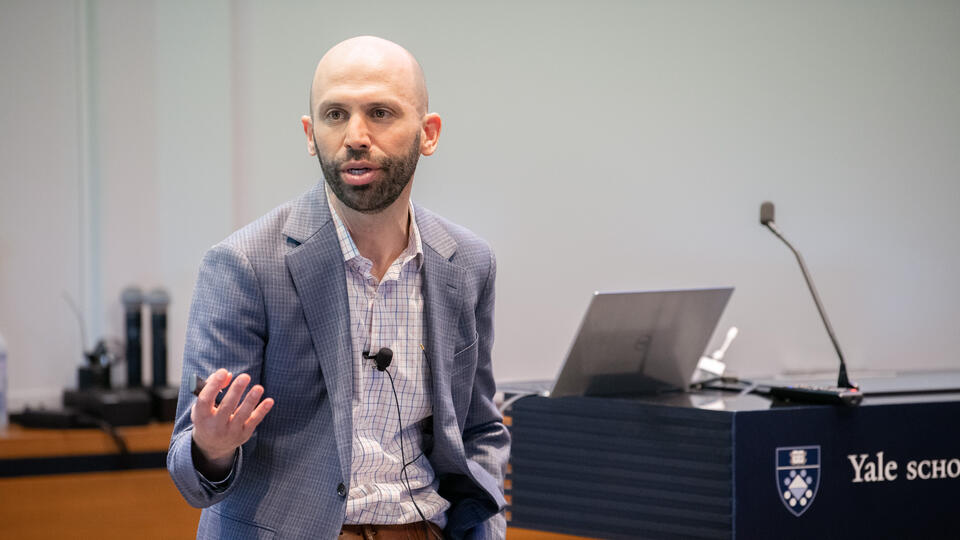
New Haven, CT, April 9, 2003 - The Yale School of Management hosted a lively discussion of Professor Robert Shiller's new book, The New Financial Order: Risk in the 21st Century, at the Yale Club of New York City last night. In The New Financial Order, Professor Shiller unveils his plan for our financial security by describing new ways to hedge against the ever-increasing risks that society faces. His previous book, the bestselling Irrational Exuberance, generated much interest around the world and warned of the likely explosion of the stock market bubble in the spring of 2000, and published a day before the market crash.
The discussion, moderated by William Goetzmann, Director of the Yale School of Management's International Center for Finance, included Roger Ibbotson, Professor in the Practice of Finance; Robert J. Shiller, Fellow, International Center for Finance; and Herbert M. Allison, Jr., Chairman and CEO, TIAA-CREF and member of the Yale School of Management Advisory Board. Over 300 business leaders, alumni, and friends of the school attended the event, which was jointly hosted by the school's International Center for Finance and its Alumni Association of New York City.
In Irrational Exuberance, Robert Shiller cautioned that society's obsession with the stock market was fueling the volatility that has since made a roller coaster of the financial system. Less noted, was Shiller's admonition that infatuation with the stock market distracts us from the more durable economic prospects which lie in the hidden potential of real assets, such as income from livelihoods and homes.
In his new book, The New Financial Order, Shiller describes new ways to use information technology and new financial instruments to hedge against a variety of risks that society faces - risk of job loss, risk of declining home values, macroeconomic risks, and much more. Informed by a comprehensive risk information database, this new financial order would include global markets for trading risks and exploiting myriad new financial opportunities, from inequality insurance to intergenerational social security. Just as developments in insuring risks to life, health, and catastrophe have given us a quality of life unimaginable a century ago, Shiller's plan for securing crucial assets promises to substantially enrich our condition.
The Yale School of Management's International Center for Finance (ICF) focuses its research on the critical issues facing the global financial community, including topics such as the development of capital markets, the functioning of the business corporation, how investment decisions are made, and how security prices evolve.
Drawing on the scholarship of distinguished scholars from throughout Yale University, the ICF is the only leading academic institution in the United States that combines interdisciplinary research in its study of finance. Throughout the year, the ICF hosts conferences and seminars on a range of topics in finance.
To learn more about the International Center for Finance and its latest research, visit http://icf.som.yale.edu/.
The Yale School of Management Educates Leaders for Business and Society. To learn more about the school, visit http://www.mba.yale.edu.
For more information about The New Financial Order, visit http://www.pupress.princeton.edu.
Biographies of Participants
Robert J. Shiller is the Stanley B. Resor Professor of Economics at Yale, and Fellow at the Yale School of Management's International Center for Finance. He has written about financial markets, behavioral economics, macroeconomics, real estate, statistical methods, and public attitudes, opinions and moral judgments regarding markets. His book Irrational Exuberance (Princeton University Press), an analysis and explication of the stock market boom since 1982, won the Commonfund Prize, 2000, and was a New York Times bestseller. Professor Shiller is co-founder of Case Shiller Weiss, Inc. in Cambridge, Mass., an economics research and information firm, and a co-founder of Macro Securities Research LLC in Cambridge, which promotes securitization of unusual risks.
William N. Goetzmann is an expert on a diverse range of investments, including stocks, mutual funds, real estate, and paintings. His research topics include forecasting stock markets, selecting mutual fund managers, housing as investment, and the risk and return of art.
Roger G. Ibbotson is an expert on capital market returns, cost of capital, and international investing. He is Chairman and Founder of Ibbotson Associates in Chicago, New York and Tokyo, which provides consulting services, software, data, and financial publishing for financial institutions and investment advisors.
Herbert M. Allison, Jr. (Yale College '65) is Chairman, President, and Chief Executive Officer of TIAA-CREF. Mr. Allison joined TIAA-CREF after a 28-year career at Merrill Lynch & Co., Inc., where he last served as President and Chief Operating Officer until 1999.
Professor Shiller has this to say about how financial innovation can be applied to the situation in Iraq:
After Saddam's regime is removed, there will be a great deal to do in Iraq just in restoring conventional financial institutions. The destruction of modern economic institutions since Saddam took control of Iraq has left that country in a desperate economic situation. As a result, most of the Iraqi GDP has consisted merely of oil revenue. There is little ability for business to function normally, and hence most of the country has been virtually unemployed for many years.
Financial innovation in the Iraqi reconstruction will take the form of adapting these institutions to the peculiar situation that Iraq is now in. The transition to a modern economy will need a lot of thought. In particular, we must avoid the Russian experience, wherein, after the turmoil of the end of Soviet power, a small number of unscrupulous people were able to grab much of the Soviet Union's wealth for themselves.
Another thought is that some kind of financial contract offered to the Iraqis now could hasten the collapse of Saddam's regime. Coalition countries could offer a contract to the Iraqis (not to their government) in return for surrender, a contract that specifies an amount of aid over the coming years. The Iraqis cannot sign such a contract, but they can individually decide not to support the regime. Since the Iraqis don't trust us, an explicit financial aid contract would help to convince them of our good faith. This kind of arrangement could be adapted in helping other countries throughout the developing world.
For an interview with Professor Shiller, contact Dennis Manning, 609-213-5732 or dmanning@alum.wustl.edu.